Vol. 24, Issue 6
September 24, 2026
Breast cancer awareness month is right around the corner. Did you know that regular exercise after a breast cancer diagnosis is linked to a 24% reduction in recurrence, 34% fewer deaths from the disease, and 41% fewer deaths from any cause. Those are impressive numbers!
Last time, I shared about breast cancer survivor Jacquelyn Fletcher Johnson and her dragon boat experience — twenty-some breast cancer survivors paddling in rhythm in one boat, all pulling together on the water. Carrying on our exercise and breast cancer survivor theme, today you’ll meet Melanie Nix, who found her healing in almost the opposite place. Not in a boat full of other women, but alone, on the pavement, before most of us have poured our first cup of morning coffee.
Melanie Nix
Running Her Way Through – and Past – Breast Cancer
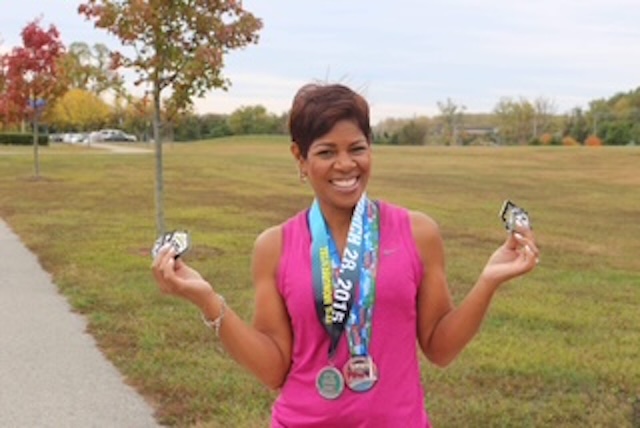
Melanie runs five miles a day, five days a week. Right now she’s training for her TWELFTH Army Ten Miler. She was a jogger before her diagnosis. She became a distance runner after it. There’s a difference, and if you talk to her for five minutes, you understand exactly what it is.
“Running has become an integral part of my life,” she told me “It’s one thing that I’m very disciplined about.” That word — disciplined — comes up again and again from Melanie. 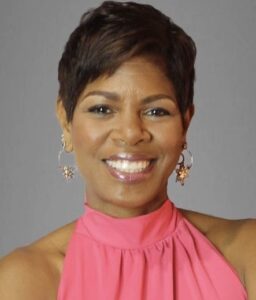 Not as a brag, but as a fact.
The research mentioned in the first paragraph backs up what she’s been doing instinctively for years now: regular exercise after a breast cancer diagnosis is linked to a 24% reduction in recurrence, 34% fewer deaths from the disease, and 41% fewer deaths from any cause. You don’t have to run marathons to get some of that benefit. A separate 2025 study found that moderate exercise is nearly as effective: survivors walking just 5,000 to 6,000 steps a day cut their death risk by 40%.
Running sits at the top of the “vigorous exercise” category, and distance running after treatment — which is exactly what Melanie does — lines up with the strongest numbers in that survivorship data. Yet only 39% of Americans even know that exercise plays a role in prevention of recurrence.
But what stuck with me wasn’t a percentage. It wasn’t a number. It was a hill.
A few years after finishing her treatment, Melanie ran her first half marathon — 13.1 miles, her first real distance race. She had trained on flat ground.
Somewhere in the middle of the course, she hit a hill she hadn’t trained for and hadn’t planned for, and for a minute she didn’t think she could make it to the top.“I had a quick moment of self-talk and reflection,” she told me, “And I reminded myself that during my training I’d had to take it step by step — just like I’d had to do every minute since my diagnosis. So, I’d take it step by step up that steep hill.”
She got over it (no pun intended). She finished that race, and she has finished every distance race she has entered since. Amplifying her view on the power of determination, she told me, “This was a powerful reminder of the mental and physical strength that we sometimes forget we have but need to rely on every day as cancer patients and survivors.
“We are often confronted with unknown situations and circumstances, and we have to navigate uncharted territory. Often, our initial response is fear, doubt, worry and a range of negative emotions. But, relying on our grit and our determination, we are able to push through and move forward. This has guided me so many times through my survival journey to keep taking it step by step, ready to face each new day – challenges and all – and keep moving forward.”
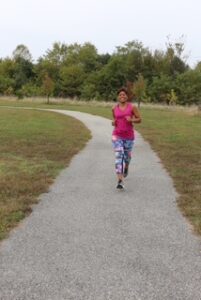 Melanie is a fifth-generation breast cancer patient — her story started when she was eight years old, watching her mother go through diagnosis, then recurrence, then loss, long before it became her own story too. Then when she was 38, she was diagnosed with triple negative breast cancer, and although she survived that round, she naturally feared the recurrence that had killed her mother and grandmother. But Melanie was determined to find a way to beat it.
Out of that she built the “#Exercising4MyLife” campaign, wrote her manifesto “Soul of a Survivor”, and created a pioneering line of breast cancer greeting cards.
Since then she has gained widespread recognition. She’s been profiled by NBC Nightly News with Brian Williams and in CURE Magazine, She has carried her message about survival and health care all the way to the White House and the Vice President’s Residence.
Melanie holds a Master of Business Administration from the Robert H. Smith School of Business – University of Maryland, College Park and a Bachelor of Arts degree from the University of Virginia.
Melanie calls herself a Reconstructionist™ — her word for someone who didn’t just survive but built an actual set of principles for rebuilding – for reconstructing her life.
Her message for breast cancer survivors focuses on giving yourself permission to change. She shares how, through her survival experience, she had to learn and accept – even welcome – change as she redefined her life and fashioned her new normal. She provides her personal experiences of inspiration, hope, and motivation for unapologetic living in the new normal. For Melanie, that includes running, and she enthusiastically inspires others to take it up as well.
If you’re planning an ERG program, a survivor event, or anything for Breast Cancer Awareness Month this October, Melanie is the perfect fit for an audience that needs to hear a blueprint for regeneration after cancer. She is an eloquent storyteller who blends wit with sensitivity and your audience will feel her thoughtfulness and compassion.
You can read more about her, view her video preview, see her speaking topics, and check her availability on her profile page on my website here.
Time Out
Saturday my husband and I returned from a late-summer vacation at a small lake up in Washington State near the Hood Canal that excludes all kinds of motor boats. I was wanting – needing, really – a respite from daily life, a place in the forest with a lake view, a deck, and comfortable chairs for reading. We got that.
We also hit it lucky with good weather and 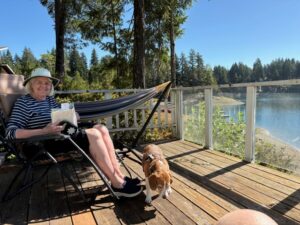 much more, including kayaking for some exercise. No running or even hiking this time, but hours just reading and relaxing. Internet, yes, but we never turned on the TV, and I worked on a jigsaw puzzle that I didn’t finish and didn’t care about finishing. I was taking care of myself and my own well being, and I highly recommend it.
Good food, a little wine, lots of rest, reading fiction for fun, and the simple pleasures of being in a new environment.
Now I’m home, enjoying my thriving garden, and getting back to work – although I’m still missing that lake view!
Until next time, I encourage you to take care of yourself for your well being and those you love.
Barbara
P.S. It’s not too late for you or your ERG to schedule a virtual program for Breast Cancer Month in October. Call me at 503-699-5031 or email me at barbara@speakwellbeing.com, and we can line up Melanie or another breast cancer speaker who fits your budget.
 For Your Well Being is published with the intention of bringing you insider speaker reports, exclusive stories about special events around the country, meeting planner tips, and fun stuff from the worlds of health and well-being. Be well and be in the know!
The Speak Well Being Group is a specialized speakers bureau, focusing on health and wellness for all types of organizations that want to foster health and well-being for their employees, members, clients, and in their communities.
Our speakers are hand-selected. They are not only experts in their fields; they connect with their audiences while bringing them life-changing information, smiles of recognition, and ultimately a sense of well-being and hope.
Finding the perfect keynote speaker for your special event or conference is my personal passion, not just once, but year after year. It brings me great joy to know that your audience was delighted and moved by the speaker we selected together. I’m committed to making the process easy, pleasant and fun.
